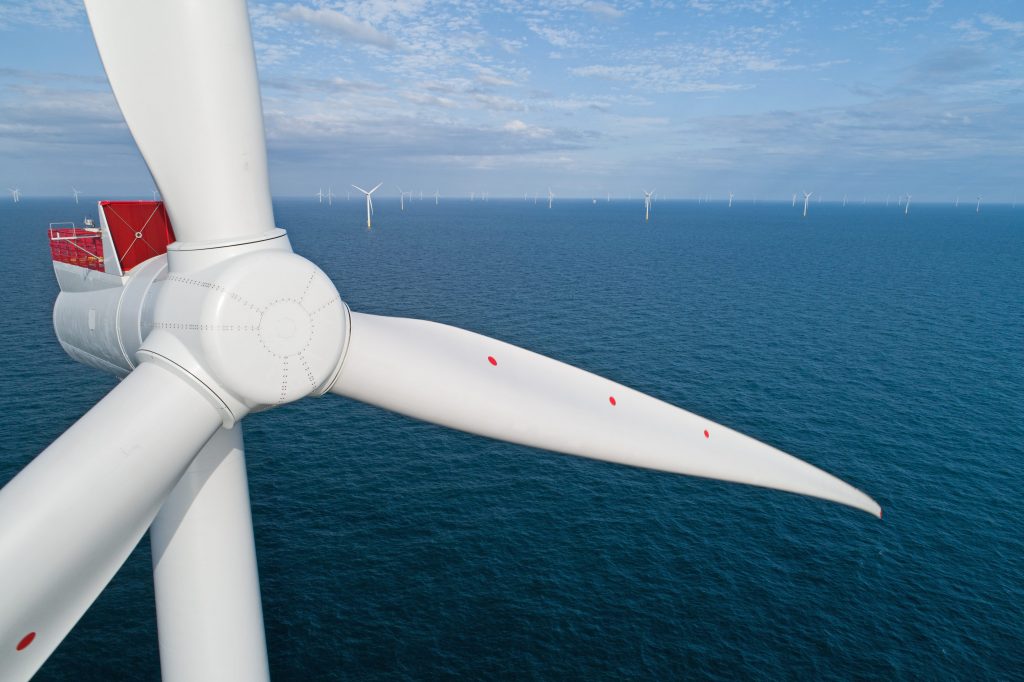
The green energy revolution has many foot soldiers and in a factory at Cockermouth in Cumbria, one such champion has achieved technology advances that are proving vital for the huge offshore wind turbines that are springing up around Britain’s coastline and beyond. [This article first appeared in Made Here Now in 2023.]
Due to the stresses transmitted by the rotating blades, which can be taller than St Paul’s Cathedral, turbine hubs must withstand enormous loads. To function, they require high-performance seals to ensure the grease inside the hub bearings cannot escape. James Walker, a little-known business on the fringes of England’s scenic Lake District, is one of the global leaders in this high-tech manufacturing niche.
This “hidden champion” of UK industry provides a classic example of a highly specialised manufacturer using technological expertise to serve a global customer base. Other UK examples include Surface Technology International in high-reliability electronics; Halma in safety controls; kettle thermostat maker Strix; and Naim, a leader in specialist audio.
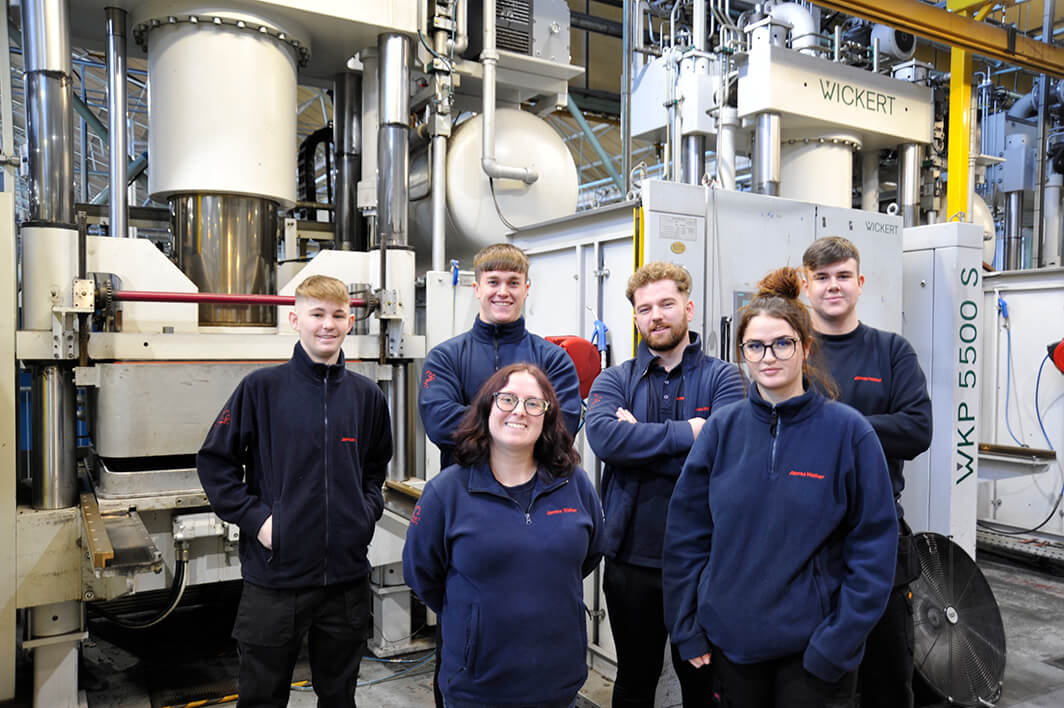 Apprentices help “safeguard the future” at James Walker’s Cockermouth plant: left to right, back row – Dainton McPherson, Sam Barker, Matt Purdy, Harvey Dustin; front row – Natalie Deacon, Nicole Sinton
Along with most niche businesses, James Walker makes complex, high-value parts in low volumes in a market with few competitors. “We don’t make simple stuff,” says David Jackson, James Walker’s finance director.
As Geoff Teasdale, product manager at Cockermouth, points out, seals are the ultimate fail-safe component. “Often the consequences of fluid leakage [from a seal] can be highly negative. The offshore wind turbine industry provides us with many challenges. The cost of failure is unthinkable because of the disruption this would cause. Costs of maintenance and repair are high. At the same time the industry is very competitive. There is a continual need to drive down costs.”
Much of James Walker’s global strength comes from its expertise in materials such as high-performance elastomers, polymers, composites, metals and engineering plastics. A small team at the factory develops innovative materials that offer new or enhanced properties for the final product.
“Every few weeks we develop and make something new for the benefit of customers,” says Teasdale. The plant manufactures for its own use roughly 700 different rubber-based compounds, using secret recipes.
Cockermouth is the biggest of James Walker’s 10 factories, six of which are in the UK. The company has a handful of competitors in seals, including Freudenberg and Merkel in Germany, Italy’s Carco, Parker Hannifin of the US and SKF and Trelleborg of Sweden. Employing almost 2,000 people globally, with about 400 at Cockermouth, James Walker had sales in 2021/22 of £181m, 80 per cent outside the UK.
Seals account for two-thirds of the company’s revenues, the rest coming mainly from another specialist set of components, track-bed systems – packages of materials laid on railway tracks to reduce noise and vibration. James Walker makes about 20 broad families of seals for uses including rotary motion or hydraulic applications. Within these families are about 750,000 product types – of which 300,000 come from the Cockermouth site.
To maintain its technology leadership, James Walker is keen to recruit young employees and develop their skills, especially through apprenticeships. “Employment of younger people through mechanisms such as apprenticeships is a big part of our measures to safeguard the future of our business,” says Jackson.
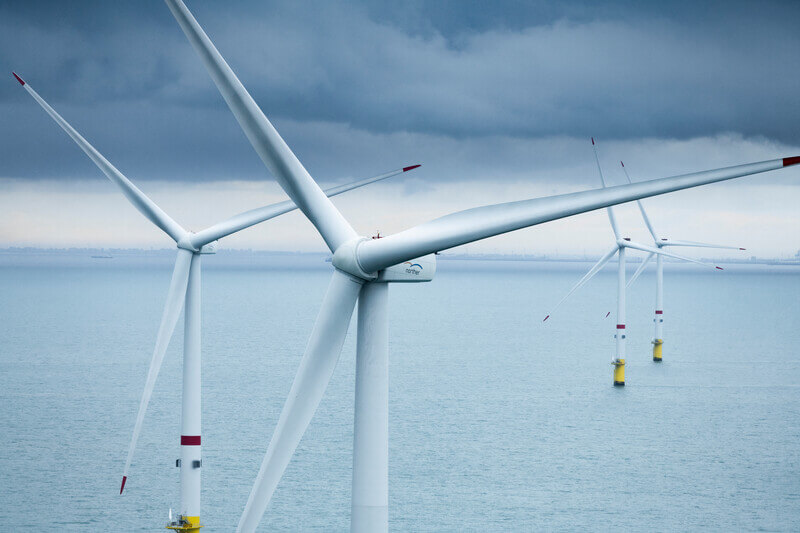 The biggest wind turbines contain thousands of seals, of which a small number – such as those made by James Walker – are vital to keeping the equipment operating reliably
Hannah Petrie, the company’s learning and development adviser, points also to the benefits to existing staff of taking in younger people, for instance through giving the older workers the chance to pick up fresh ideas and pass on skills to a new generation. In 2022, the company – a Made Here Now sponsor – recruited five apprentices at Cockermouth, the highest figure since 2018, and this year plans to add three more.
The wind turbines being deployed offshore in many parts of the world – especially the North Sea – represent a big growth area for James Walker, which was started in 1882 by a Scottish railway engineer of the same name. Just under half of the company is owned by family shareholders descended from Walker or his principal business partner.
Each blade on the biggest wind turbines is more than 120 metres long. The “swept area” of each turbine’s rotors is equivalent to around seven standard football pitches.
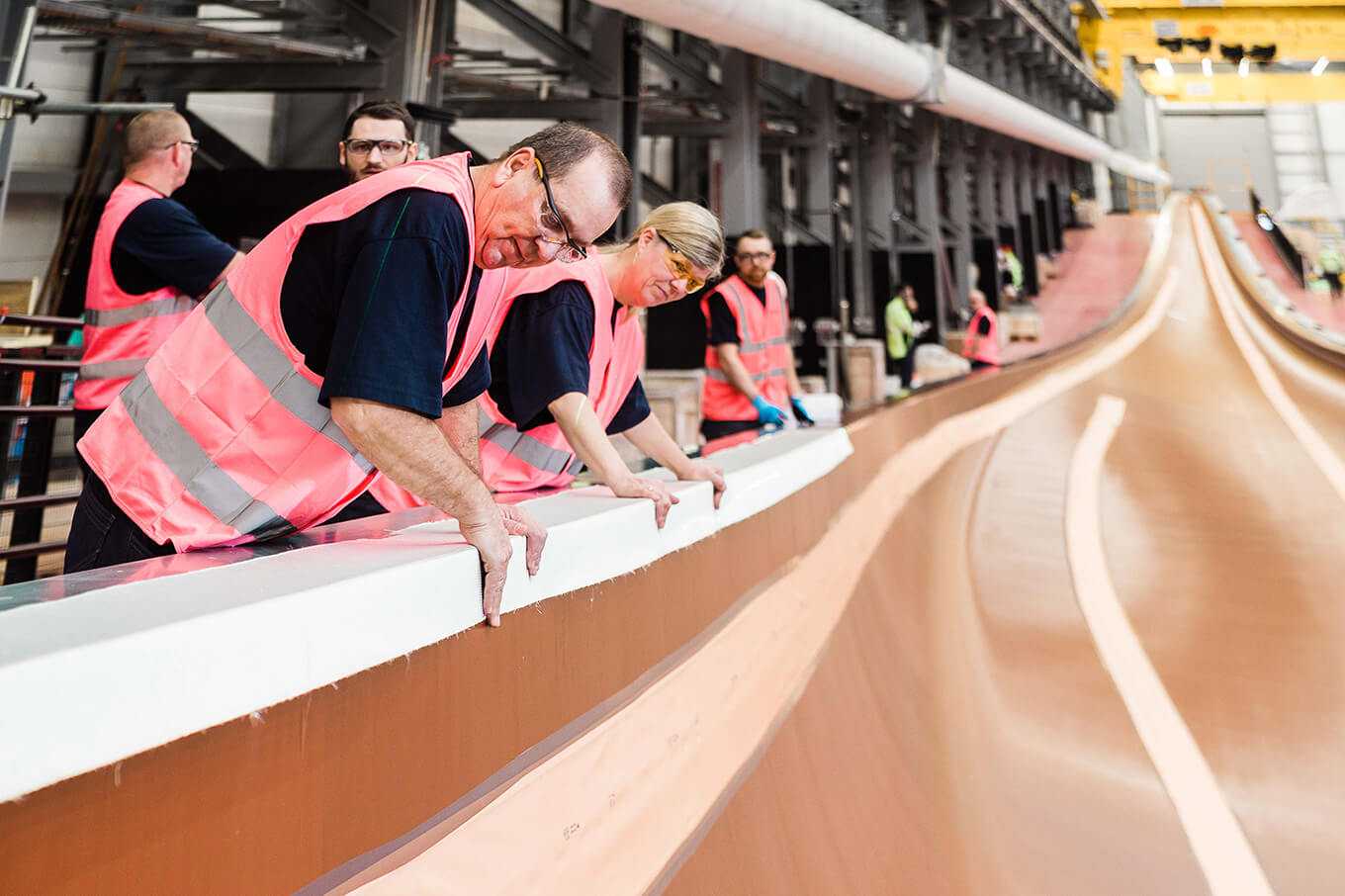 Siemens Gamesa’s factory in Hull makes wind turbine blades more than 100m long, many of which end up in North Sea installations
Repairing the inner parts of offshore wind turbines – or even doing routine maintenance – can be difficult due to bad weather. James Walker therefore goes to great lengths to ensure its seals achieve close to 100 per cent reliability in harsh environments. As a result, customers pay a premium for seals that they know have a minimal likelihood of developing a fault. “We sell people peace of mind,” says Teasdale.
Seals for wind turbines are a relatively new addition to James Walker’s product portfolio, accounting for about 5 per cent of its revenues from seals, compared with next to nothing a decade ago.
In the case of wind turbines – the biggest manufacturers of which include Siemens Gamesa of Spain, Denmark’s Vestas, General Electric of the US and Chinese businesses including Goldwind – each machine contains thousands of seals of all types, normally for low-risk applications. The main bearing assembly in a typical turbine has between two and four rotary seals that are critical to the performance of the complete machine.
Siemens Gamesa operates a big blade factory in Hull, north-east England, that is seeing a £186m expansion due to double its output. Among the plant’s products are giant blades for offshore turbines that measure more than 100m long.
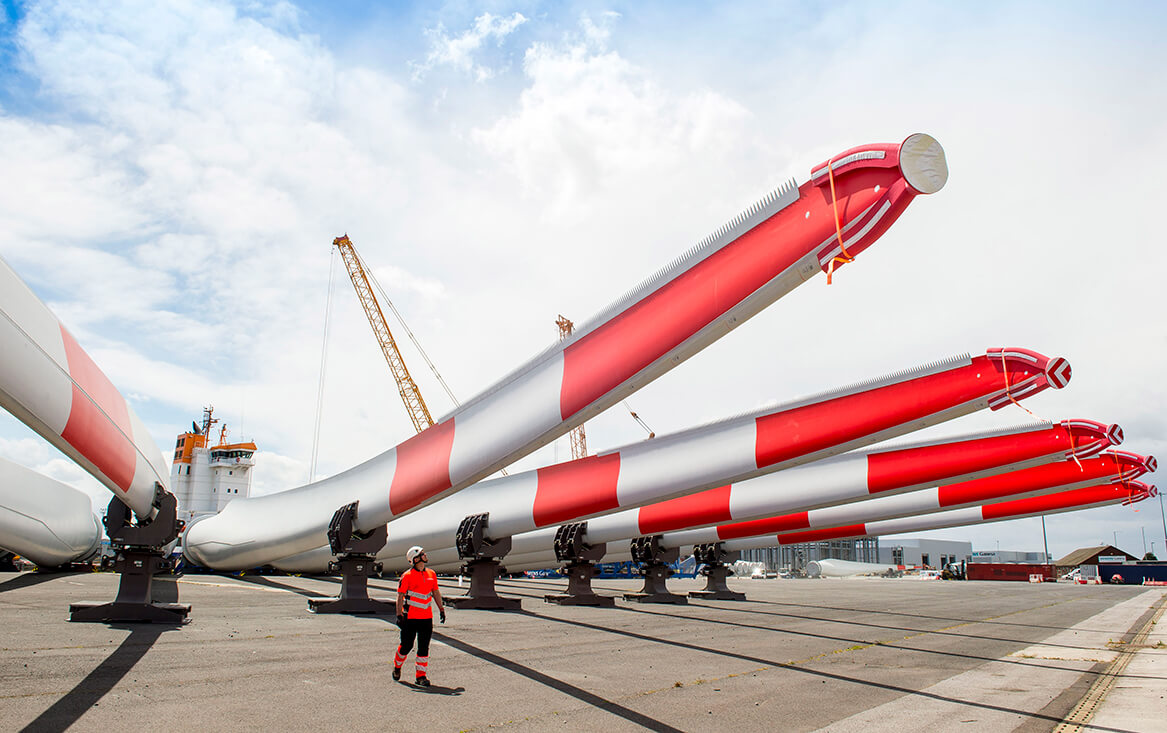 At the cutting edge: giant wind turbine blades are pictured awaiting transportation to an offshore site
Other industries James Walker serves include chemicals manufacturing, water treatment, nuclear power, marine propulsion and oil and gas production. Around 85 per cent of its sales are made to order, often to a customised design. A typical order size for the Cockermouth plant adds up to no more than about 12 seals of one type, often manufactured for the sole use of a single buyer.
James Walker has more than 10,000 customers in its seals division, including big steel and chemical companies, makers of industrial bearings and many wind turbine producers. The biggest seals James Walker makes – those that fit inside the biggest wind turbines, for example – are several metres in diameter and weigh hundreds of kilos. Its most expensive seals sell for up to £70,000 each, though smaller more everyday models can cost £1.
Innovation is a constant mantra. For example, the company’ s engineers devised a special spring to fit inside the elastomer-based body of the seals it makes for big wind turbines to adjust for changes in wind direction and speed. This allows the component to maintain an even load on the rotor hub as the blades rotate, reducing wear while also cutting production costs by 25 per cent.
