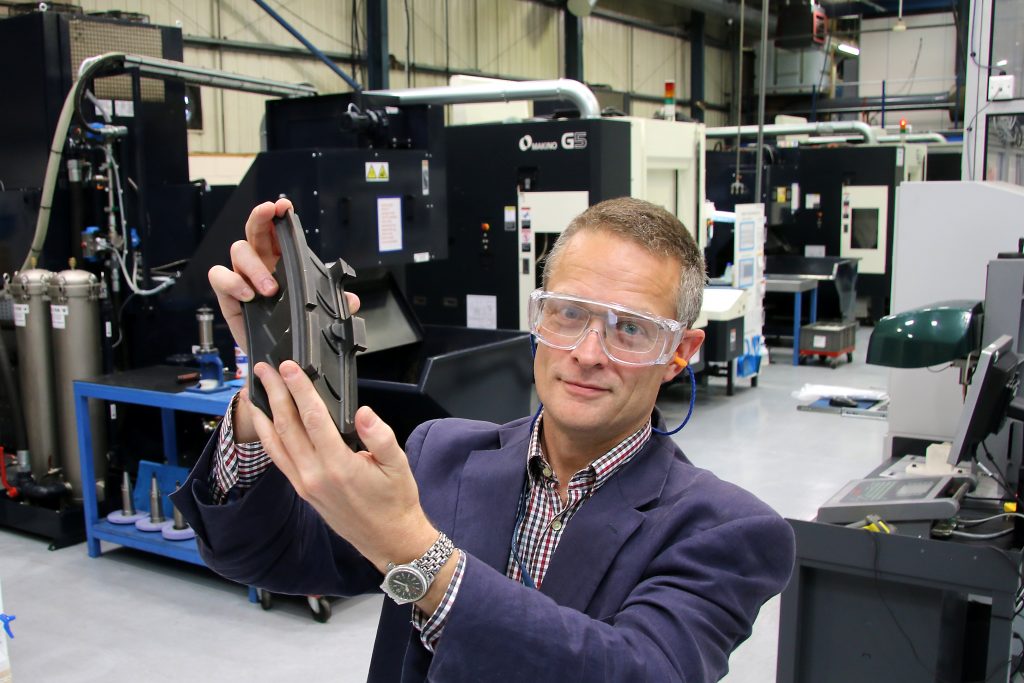
With Brexit-related uncertainty overshadowing the UK economy, would you bet your company’s future on a new product area in one of the world’s most technologically demanding industries? That’s what Andrew Churchill (pictured above) did with his family-owned aerospace business – and the gamble seems to be working.
Churchill is executive chairman of JJ Churchill, based near Leicester. It makes key parts for jet engines and is an important supplier to Rolls-Royce, the big British aerospace manufacturer.
Since 2016, JJ Churchill has invested £10m in its growth programme. It plans to double annual sales over the next two years, on the back of orders stretching to 2029 of £210m, mainly from Rolls-Royce and Safran, the French aero-engine maker. [Note this article was originally published in 2019.]
Central to Churchill’s plans is building on the technical prowess of his company’s 160 employees, with an emphasis on recruiting young people.
The company has 10 apprentices, mainly in their 20s, and aims to take on five each year. Churchill is an adviser or governor of three schools in the Midlands and is on the steering board of the 5 Per Cent Club, a group of UK companies promoting apprenticeships.
“Giving teachers and school pupils an accurate view of UK manufacturing is vital if companies such as ours are to recruit the workforce we will need for the next 20 years,” he says.
If the plans work, Churchill thinks that by 2022 the company could employ 200, up from 90 a decade ago.
The 50-year-old says his company is a good example of a UK “niche” manufacturer, “involving complexities of tolerances, materials or geometries”. He adds: “The businesses aren’t necessarily the cheapest. But they compensate by being innovative and offering superlative service.”
JJ Churchill’s most important customer – Rolls-Royce – plays a crucial role in UK manufacturing. Besides employing more than 20,000 people in Britain, the company has roughly 2,300 UK suppliers. It buys parts and services from them worth some £2.3bn annually – about a third of its global purchase bill.
Rolls-Royce – which has a reputation for tight management control and rarely discusses its suppliers either in Britain or elsewhere – has recognised JJ Churchill with a series of technology awards. The company was set up in 1937 by Andrew Churchill’s grandfather. It is among a small number of preferred suppliers for several of Rolls-Royce’s families of small engines that power corporate jets.
JJ Churchill is playing a leading role in remedial work on compressor blades for Rolls-Royce’s Trent 1000 engines (pictured below) that power the Boeing 787 Dreamliner. Rolls-Royce discovered in 2018 that some of the blades on these engines were wearing quicker than had been anticipated.
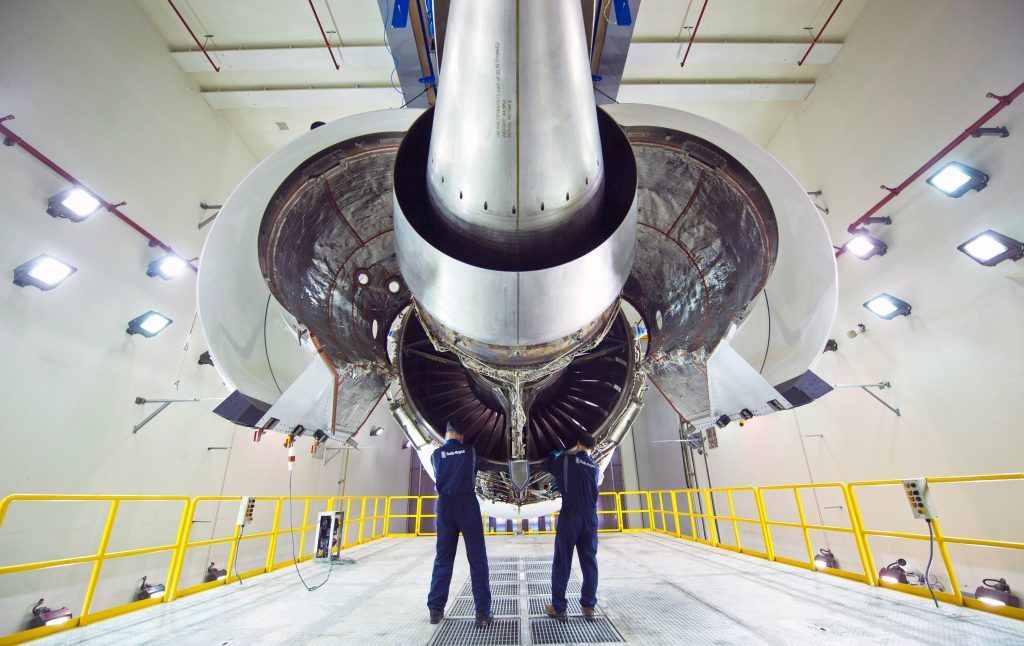
Due to the mishaps with the Trent 1000, Rolls-Royce faces a £1.6bn bill to pay for the remedial programme (including compensation to affected airlines) in the four years to 2021. The problems have grounded dozens of the aircraft and annoyed airlines such as BA and Virgin that operate the Dreamliner.
In an update in August 2019, Warren East, Rolls-Royce’s chief executive, said the engine issue was still “causing a number of our customers significant disruption”.
Apart from JJ Churchill, a handful of other companies – only one of which is also based in Europe – are working on the programme to produce a new higher-durability form of the compressor blades that power the Trent 1000. The UK company’s work on this programme is a strong indicator of its technological prowess – even though it provides only a modest amount of revenue.
JJ Churchill’s key niche is making metal blades for jet engines. These fit into the compressor or turbine of a jet engine and play a central role in providing thrust for the aircraft.
The blades operate under immense stress. Each can be just a few centimetres long. Yet they withstand forces equivalent to a weight of about 10 tonnes (equivalent to two adult elephants) hanging off them.
In 2016 JJ Churchill decided to stop making compressor blades for aircraft engines (and other types of gas turbine, for example for power generation) and concentrate solely on turbine blades for aerospace.
“We needed to move up the ‘technology curve’,” says Churchill. “Compressor blades are more straightforward to manufacture and at greater risk of becoming commoditised. Though challenging and risky, from a strategic perspective, turbine blades seemed the way to go.”
Behind the strategy lie the differences between the two types of blade. Compressor blades “squeeze” air to increase its pressure. The air is then mixed with fuel and ignited, with the resulting hot gases powering the engine’s turbine blades. These are generally smaller than compressor blades but must withstand greater stresses and extremes of temperature.
As a result, turbine blades have more exacting specifications. The £1,000 cost of a typical turbine blade could be twice that of a comparable compressor blade.
Because they involve more technical challenges, fewer manufacturers globally compete in the market for turbine blades, compared with compressor blades.
“Once we decided on this route it meant we had to invest a lot in new machines to make the higher specification blades. We felt that the company had the technological capability to make a success of the move and it would eventually lead to new markets and higher sales,” says Churchill.
According to Churchill’s plans, his company’s forecast sales this year of some £29m should rise to about £60m in 2021/22, with two thirds of the total coming from turbine blades, up from zero three years ago.
The work JJ Churchill is doing on the Trent 1000 engines’ compressor blades to some degree diverts the company from its new focus on turbine blades. But the company sees it as a highly worthwhile exercise not least because it demonstrates a high level of capability for a medium-sized company. In this project, Rolls-Royce’s engineers designed the new blades but left JJ Churchill to decide how to make them.
The manufacturing process involves machining high-strength pieces, made from titanium-based alloys, with accuracy of up to 6 micrometres. “Our job was to work out how to make the blades efficiently and ensure they operate as designed,” says Churchill.
This article appeared in Made Here Now on August 19 2019
