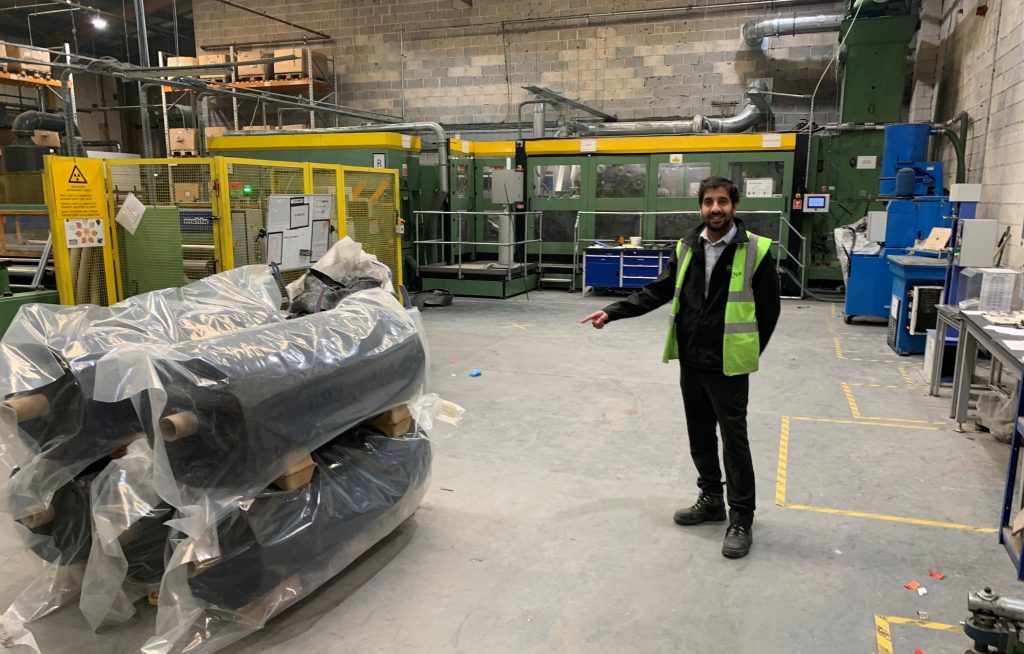
An innovative recycling process for carbon fibre, developed by a UK company, could unlock a new source of the expensive “wonder material” – helping to accelerate the transition to an energy-efficient future.
Carbon fibre is both extremely light and strong, which gives it many potential applications, notably in products designed to reduce energy consumption. But its high cost and global supply constraints have limited the use of carbon fibre.
Gen 2 Carbon – the company that invented the process – says a reliable and low-cost recycling method could provide fresh supplies by recovering the material from discarded products that would normally be put into waste streams. Currently operating from a factory in Coseley near Wolverhampton in the West Midlands, the company plans to open two overseas plants in Australia and the US within the next two years.
The opportunities, says Frazer Barnes, Gen 2 Carbon’s chairman and main shareholder, are “massive”. He adds: “Sustainability is becoming increasingly important [and] use of carbon fibre is growing due to the many applications for the material especially in the light-weighting of vehicles needed to save energy costs and in non-fossil fuel energy systems.
“While supply of virgin fibre is subject to limits, it makes sense for consumers of carbon fibre to consider using more of the recycled form for specific applications, especially as the material comes with a cost advantage.”
Carbon fibre became commercially available in the 1950s and is normally formed into a mesh or woven structure and used to reinforce plastics. Big users include aerospace and high-performance car and wind turbine manufacturers, as well as makers of sporting goods such as fishing rods. An aircraft made with carbon-fibre composite panels is likely to weigh 20-40 per cent less than one using aluminium, creating a big saving in fuel costs over its life.
Gen 2 Carbon has emerged as a leader among a small group of businesses globally that feel they have solved most of the technical problems in reclaiming carbon fibre from spent products. There could be big payoffs for the industrial world from a fully worked-out recycling process.
In 2023 about 130,000 tonnes of carbon fibre is likely to be used globally, about twice as much as 10 years ago. However, consumption is much lower than steel and aluminium, two of the biggest industrial materials for which annual demand stands at about 1.5bn tonnes and 60m tonnes respectively. Only a small amount is currently recovered, mainly in the form of manufacturing waste.
The work by Gen 2 Carbon underlines how efforts from sometimes little-known UK manufacturers have the potential both to have a big impact on the wider economy and offer career opportunities for young people. Gen 2 Carbon employs just 16 people though Barnes says the number should double by the end of 2023. A key remit for Made Here Now is to highlight innovation in UK manufacturing likely to create economic growth and jobs.
Depending on how it is formed a carbon composite is 5-10 times stronger than the equivalent steel part. One obvious drawback is that carbon fibre is typically 20 times more expensive than steel and 10 times more than aluminium. However recycled carbon fibre might sell for 30 per cent less than the virgin form, while offering comparable properties. This would create a big incentive for at least some users to consider this option.
Green Alliance, an environmental group, says: “A successful recycling supply chain…would mean cheaper inputs for manufacturers, helping them to break into new markets for applications where the material was previously too expensive and compete better on cost and quality.” Others have pointed out how a successful recycling method could reduce the potential for a troublesome waste problem. According to researchers at the University of Sydney, annual accumulation of carbon fibre-based waste materials from the aircraft and wind turbine industries alone could reach 840,300 tonnes by 2050 if suitable recycling methods are not adopted.
Big users of carbon fibre in sectors such as aerospace, marine and Formula One racing are monitoring developments in carbon fibre recycling to work out the possibilities. A key part of the future business for Gen 2 Carbon could be in the UK – which is Europe’s second biggest market for carbon fibre after France – even though 95 per cent of the material it reclaims and sells is currently exported.
Barnes hopes that interest in his business’s technology in the UK can be energised, possibly with the assistance of the UK government in boosting awareness of carbon fibre recycling.
“We would like to gain more UK customers. But awareness in the UK of the opportunities…is sadly limited. It would help if the UK were to develop a proper strategy for new materials development [including recycling opportunities] and how this will play a part in encouraging the industries we need. But I am sorry to say this is something the government is a long way from devising.”
One prominent supporter of Gen 2 Carbon’s ideas is John McQuilliam, director of engineering at the composites division of ProDrive, a Banbury-based motor sports and technology business that supplies the automotive and aerospace industries.
“The recycled carbon material we get from Gen 2 Carbon can be incredibly useful in a range of applications,” he says. “The material is close to isotopic [having the same characteristics in different directions] which means in certain applications such as in car body panels it’s strong and resilient. One advantage over the virgin form is that it can cost 30% less. We use the recycled form for a fairly high percentage of our total requirement.”
Another backer is Qu Li, a China-born automotive expert and driving force behind Morris Commercial, a UK-based company developing a series of electric vans. The company has become a leading customer of Gen 2 Carbon. “Well above 50 per cent” of the body panels in Morris Commercial’s vehicles are made from recycled carbon fibre from the Gen 2 Carbon process, according to Li.
“We feel that using recycled material rather than virgin carbon fibre provides a highly useful environmental benefit and should help us establish ourselves as a company operating in a sustainable manner,” she adds. “What Gen 2 Carbon has been able to offer has been hugely beneficial.” While Morris Commercial is making vans only in low volumes, it says it has secured significant new investment and is hoping to announce large scale production plans soon.
In 2022 Gen 2 Carbon produced 600 tonnes of reclaimed carbon fibre from its Coseley factory. By the end of 2023, it plans to move its UK operations to a new site nearby. By 2027, the company wants to have three recycling plants globally with total output of 5,000 tonnes, giving annual revenues of up to £150m.
While Carbon fibre was invented in the 19th century, it was only in the 1950s that large-scale production became possible, thanks to technical advances. Much of the early work was done by the once-world-leading UK chemical manufacturer Courtaulds. Now there are no significant UK producers. The main makers of the material include Teijin, Mitsubishi Chemical and Toray /Zoltek of Japan, DowAksa (US/Turkey), SGL Carbon (Germany), and the US’s Hexcel.
Gen 2 Carbon has spent 20 years – under a variety of names and with different financial backers – developing its technology. Barnes became a shareholder in 2021, when the company adopted its current name. Over the past five years, including investments by the previous owners, Barnes says Gen 2 Carbon has spent £10m developing its technology.
It aims to raise another £8m in the coming year to move ahead with its plans. Other companies globally with carbon fibre recycling facilities – all operating on a small scale – include Mitsubishi Chemical Advanced Materials of Japan and the US companies Carbon Conversations and Vartega.
The article first appeared in Made Here Now
