Bluetree is a UK manufacturer that has diversified from rapid-turnround printing into making sophisticated hospital masks and other forms of medical protective equipment, including the highly-prized “meltblown” material used for masks that is rarely produced in Britain. It has set aside £18m for investments in machines and research and hired more than 200 new employees to make a workforce that in 2021 climbed to 600.
The company – based near Rotherham – is an exponent of the “clever manufacturing” that thrives in Britain and is in an excellent position to assist an economic recovery, especially if it is given more support and recognition.
In my view, clever manufacturing is a more satisfactory term than the poorly-defined – and somewhat tired – phrase “advanced manufacturing”. I say this as someone who like many others have used advanced manufacturing often to denote anything linked to production industries that is novel and innovative and seems to be having an impact.
But now is the time to start thinking more precisely about what is meant by these labels, and what are the assumptions behind them.
Clever manufacturing encompasses all the sectors politicians call to mind when discussing top-level production, including biotech, new materials and robotics. But it also takes in other areas, for instance the creation of specific craft-based metal goods and textiles that often require a blend of old and new technologies plus imaginative design.
Basically a clever manufacturer under this broad definition is one that can punch above its weight in a tough competitive environment, using a mix of skills knitted together by bold management.
The much-discussed digitisation processes of Industrie 4.0 – used to link manufacturing processes and improve product development and customer engagement – are important. But they are seldom the main reason why some manufacturers are better than others.
London-based Brompton Bicycle, the UK’s leading maker of two-wheelers, is a keen exponent of digitisation. But it owes its global reputation to other ideas: an ingenious design dating from the 1970s based around 1,200 hard-to-replicate components, plus its perfection of brazing, a specialised technique to join light and thin metal parts, invented more than 4,000 years ago in ancient Egypt.
The company has close to 60 specialised brazers, most of them young, with almost all of them having been tutored by Abdul El Saidi, the company’s Lebanon-born head of brazing training.
Brompton has expanded strongly in the past decade, announcing sales of £106.9m in 2021-22, up 40 per cent from the previous year.
It employs more than 800 people, most of them in its factory in Greenford, West London. The number has grown since 2021 by more than 300, with many new recruits aged less than 30. Three quarters of the company’s output is exported.
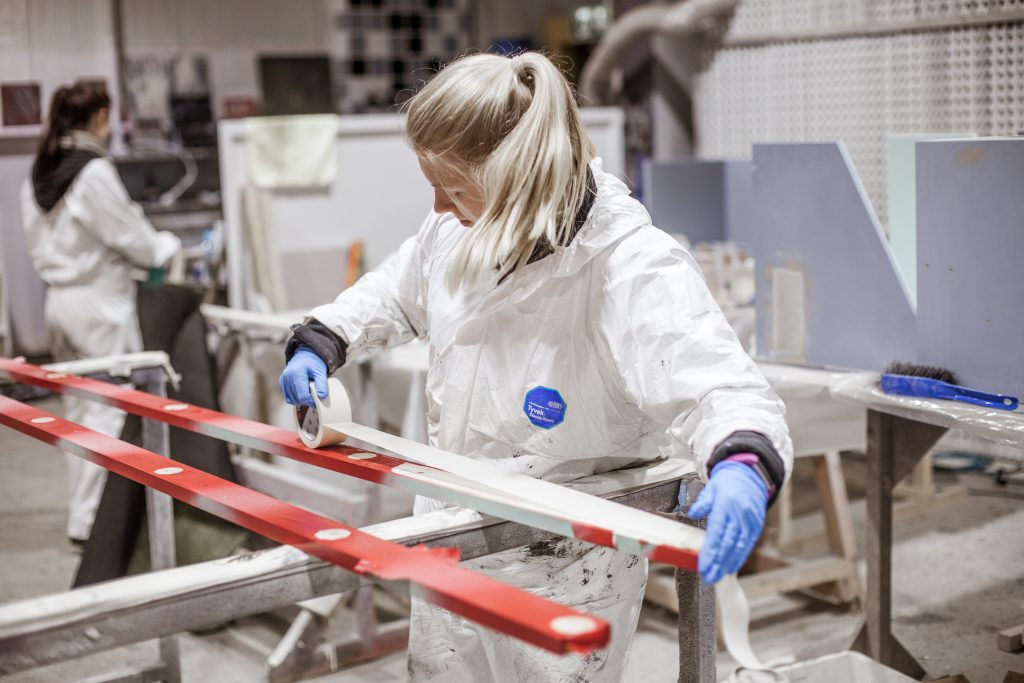
Another top firm – unlikely to fall into the conventional category of advanced manufacturing but which slips easily into the broader definition – is Stage One. With an HQ in disused aircraft hangars near York, it uses technologies from 3D printing to woodwork to make sometimes giant artefacts for events such as art installations and Olympics ceremonies. Featuring in the photo accompanying this article is an employee working on the painting process linked to one of Stage One’s products.
Battered by the pandemic, the company is recovering, helped by big export orders from the Middle East. Asked to explain why the business is successful, managing director Tim Leigh says: “We are brave. We take on one-off projects that others would avoid, because we are confident we can find the answers.”
With manufacturing in the round accounting for 10 per cent of the UK economy, the proportion that would fit into the slot of “clever” probably accounts for at least a third of this. The identities of other businesses that could be labelled in this way can be glimpsed in a new Made Here Now survey based on interviews with 107 young people working for 76 leading UK manufacturers, in sectors from military aircraft to mattresses.
In discussing the future, it would be wrong to paint too rosy a picture. Many UK manufacturers – irrespective of whether they can be put in the “clever” camp – have been hit by Brexit-linked disruptions to trading, along with supply shortfalls and rising raw material prices related to the pandemic and its aftermath.
But notwithstanding these problems, many of the UK’s clever manufacturers would seem to be in a good position to expand. Manufacturing in the round is a high-productivity sector, with output per hour around 12 per cent higher than the UK average, mainly because it requires relatively high levels of capital investment, a factor that almost always adds value to what employees can achieve with their hands and brains.
The industry offers a spread of employment from top-grade R&D engineers to people doing manual jobs, and a distribution of operations scattered around Britain. Wages are generally relatively high – at least in the more technology and craft-intensive parts of the sector.
It therefore remains a mystery as to why the prime minister and other top politicians have failed to give clever manufacturing greater attention in their pronouncements about how to boost a recovery. The recent emphasis in ministerial announcements on vocational and technical training is indeed welcome but there has been little targeted effort to help this specific sector or even acknowledge that it exists.
A version of this article previously appeared in Linked-In in 2021.
