
The death of Lord Kumar Bhattacharyya – founder and chairman of Warwick Manufacturing Group – has robbed the UK of a charismatic leader who has played a key role in the reawakening of British manufacturing in recent years.
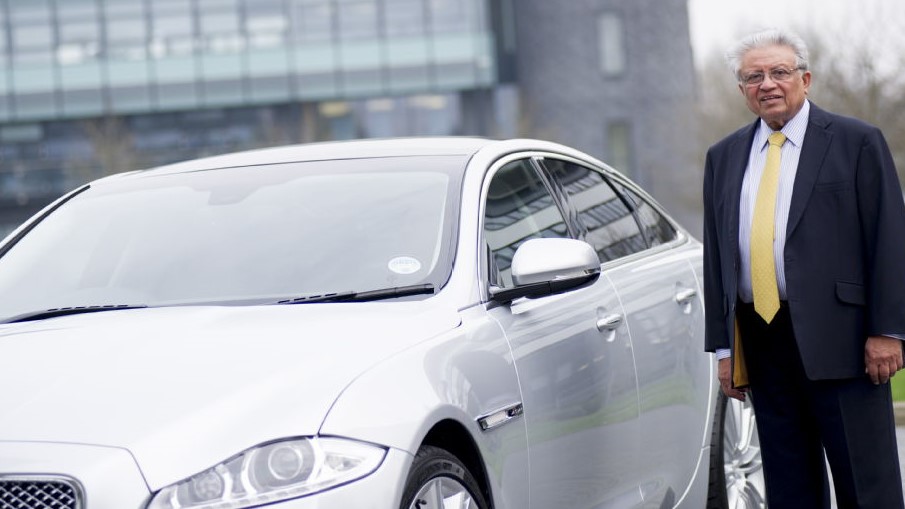
Lord Bhattacharyya built up Warwick Manufacturing Group into one of the world’s most influential applied research centres. He is pictured above with Ratan Tata, former chairman of the Indian industry group Tata, and among the many global business leaders who he counted as collaborators and friends.
Combining the wiles of a politician with the panache of a showman, the India-born peer conveyed globally through his teaching organisation powerful new ideas on how to succeed in 21st century industry. [Note this article dates to 2019 – when Bhattacharyya died.]
Asked almost 20 years ago about the strategies manufacturers should adopt to win out Bhattacharyya answered: “They should develop their skills, learn to transfer technology, and formulate an international strategy. Then they have a chance.”
Other principles that Bhattacharyya set out stress the importance of collaboration. “Just as a brain surgeon could never perform in isolation, a top manufacturing engineer needs a team of people,” was one Bhattacharyya aside.
Aided by guidelines established by Bhattacharyya, successive UK governments have done more to recognise the role of manufacturing as an economic lever, a view enshrined in the UK’s industrial strategy, unveiled in 2017. Bhattacharyya spent several years advising Nelson Mandela on an industrial policy for South Africa after apartheid.
Bhattacharyya’s biggest legacy is WMG, which he set up in 1980 as part of the University of Warwick. WMG is one of the world’s foremost manufacturing research and teaching groups with 600 staff and an annual turnover of £200m.
Development work at Warwick Manufacturing spreads across topics from electronics to composites materials, usually organised with an industrial partner
Sir Vince Cable, industry secretary during the 2010-15 Conservative-Liberal Democrat government, said Bhattacharyya was “a giant of British manufacturing…He believed passionately in the value of manufacturing and practised what he preached.”
Sir Richard Lambert, a former director general of the Confederation of British Industry and former chancellor of Warwick University, said:” I first met Lord Bhattacharyya in London back in the 1980s. He was dropping lots of names, and talking very big, and I couldn’t quite believe he was for real. So I went up to see him at WMG – and was completely blown away by what I found.
“The bosses of half the country’s biggest engineering companies were sitting around his department in their cardigans, drinking coffee and being absolutely inspired by what he was saying. Namely, that they could dramatically up their game if they combined intellectual rigour with commercial acumen. He spoke a language that I hadn’t heard in the UK before, and I thought he was inspirational.”
The Warwick guru, said Lambert, showed through his achievements that “excellence was both possible and necessary”.

Lord Bhattacharyya had a formidable list of contacts: here he shows Theresa May and Philip Hammond (in the days when they were UK prime minister and chancellor of the exchequer) around Warwick Manufacturing Group’s HQ.
On the international front, Bhattacharyya was particularly effective in encouraging the big Indian industrial group, Tata, to invest in the UK, notably through its 2007 move to buy Corus, the steel business that was formerly part of British Steel, and its acquisition a year later of the Jaguar Land Rover car company.
Prior to the JLR deal, Ratan Tata, then Tata’s chairman, was all set to invest in Germany as part of a global automotive industry expansion. That was until Bhattacharyya invited him to the UK to show what British vehicle engineering was capable of.
Tata said Lord Bhattacharyya played “a significant role in enhancing the visibility of high-technology manufacturing enterprises in the UK”. Ralf Speth, JLR’s chief executive, said Bhattacharyya had been “remarkable and inspirational”.
Apart from Tata, Bhattacharyya’s ideas had a big impact on other companies in India – where WMG has an impressive reputation.
Baba Kalyani, chairman of Bharat Forge, a big India-based maker of forgings with plants in the US, France and Germany, said Bhattacharyya “was always full of ideas and self-confidence…He was a guru to many Indian industrialists and business houses”.
While generally exhibiting charm and good humour, Bhattacharyya could in private be scathing about individuals in business or government who he reckoned weren’t up to the job.
He also directed scorn at those UK companies that in his opinion, failed to invest enough of their own cash in research and development, preferring to lobby for government handouts. In UK industry, he liked to say, there was no shortage of good engineers “but a lack of leadership”.
Bhattacharyya had a guileful side. This was shown when, ahead of Tata’s 2007 move to buy Corus, journalists picked up rumours that the two companies might be talking.
Anxious to head off stories that might jeopardise the deal, Bhattacharyya dismissed the conjecture as “bar talk”. For Bhattacharyya, such conversations were all part of an effort to direct the progress of UK manufacturing in in a positive direction.
Bhattacharyya – who continued as the chairman and driving force of WMG until his death – was part of a Bangalore family which had made its money in tea and steel. In his later life years he never appeared short of money and liked to be transported around in a vehicle from his fleet of UK-made Range Rovers.
Enthused by the career possibilities in production, the young Bhattacharyya arrived in Britain in 1960. Initially, he found most of the food so inedible that he lived for several days on Cadbury’s chocolate.
A year later he enrolled as an engineering apprentice at a London factory run by Lucas Industries, at that time a big maker of automotive components. (Later, Bhattacharyya bought a substantial house in Birmingham that had once been the home of Joseph Lucas, the company’s founder, and lived in it until he died
“I got into engineering because in those days this was considered sexy,” Bhattacharyya told me in 2000. “And British manufacturing was something that when I was young in India we all looked up to.”
But it did not take long for him to discover the sector’s shortcomings. “Although there were a few golden nuggets, British management (in the 1960s) lacked intellectual horsepower. The understanding of the global environment and world politics was pretty well zilch.”
Bhattacharyya’s desire to improve matters led to the creation of WMG – designed around the then unfamiliar concept in Britain of industry and academics working together. Today, WMG says it has “strong relationships” with 1,000 companies globally and has trained 35,000 students from 75 countries.
Bhattacharyya was a strong supporter of Made Here Now, set up to improve the image of manufacturing and encourage more people into it. He was a member of the project’s advisory board.
Another company that Bhattacharyya helped to bring to the UK was the big Chinese car maker Geely, owner of two large UK-based industrial businesses, the Lotus sports car company and LEVC, a pioneering producer of electric vehicles.
Carl-Peter Forster, LEVC chairman and a non-executive director at Geely, said Bhattacharyya will be remembered as “someone who made things happen”.
Lessons from a global guru
Lord Bhattacharyya has left behind numerous ideas and maxims that impart useful nuggets of insight into how modern manufacturing works.
“If you want to be a good manufacturer, you must recognise you can never be an expert in everything,” was a typical remark. “You are part of a broad manufacturing economy. You need to be part of a connected supply chain involving both manufacturing in its narrowest sense [involving physical production] and access to services and other things like software and new materials.”
Applying this dictum more specifically, Bhattacharyya said: “To make a success [for instance] of an electric car you will need a lot of technology that will almost certainly be supplied by someone else. You need connections and you need guidance.”
Venu Srinivasan is one noted industrialist who says he owes a lot to Bhattacharyya’s teaching and ideas.
In 1975 Srivinisan, chairman of TVS, a large Indian industrial group, spent a year as an apprentice in the UK at Lucas Industries, the British car parts maker where Bhattacharyya worked as a production engineer. The older man was assigned to Srinivasan as a mentor.
“Since the mid-1980s, when TVS was a regional moped company, [Kumar] has guided our vision and thinking to expand and grow into a company with a global scale and footprint,” Srivinasan says.
“Kumar guided our turnaround in the 1990s by implementing excellence in manufacturing and a lean supply chain. His vision inspired us to learn, grow and educate our people in cutting edge practices from around the world.”
On many topics, Bhattacharya had a strong opinion.
Definitions of industry: “Manufacturing is the production of goods, plus the creative services that go into them. In the past we [in Britain] have been to blame for defining manufacturing too narrowly.”
The UK without a strong manufacturing sector: “We would be heading for Doomsday. We are not gods; we cannot live on thin air, or just by using mobile phones.”
Manufactured products: “All successful products are global.”
Thoughts about Britain: “The UK is not a mass country. People have such individualistic attitudes. Getting people in Britain to work together is always fraught.”
Sir James Dyson [the technology entrepreneur]: “Dyson is good but there’s only one of him. We need more people like him.”
Brexit: “I’m worried but I think we will have a soft Brexit. Common sense will prevail.”
This article first appeared in Made Here Now on March 19 2019
